AIHubMix Blog

Announcements, tutorials, model analysis, and product updates from AIHubMix.

AIHubMix Desktop 1.0: One-Click Setup for 11 Agents, and Half-Price DeepSeek V4.1 Flash 1017 for Two Weeks

AIHubMix Desktop 1.0: One-Click Setup for 11 Agents, and Half-Price DeepSeek V4.1 Flash 1017 for Two Weeks

The desktop app finds the agents you already have installed, writes the config each one needs, and takes it all back when you want out. It ships with a launch promotion: DeepSeek V4.1 Flash 1017 at 50% off for two weeks. Tl;dr * AIHubMix Desktop 1.0.0 is out for macOS 12+ and Windows: one key for more than 700 models, and an app that sets your agents up to use it. The app is free; your agents' requests bill to your AIHubMix balance as usual. * It scans the machine for agents you already ha

7 min readAnnouncement
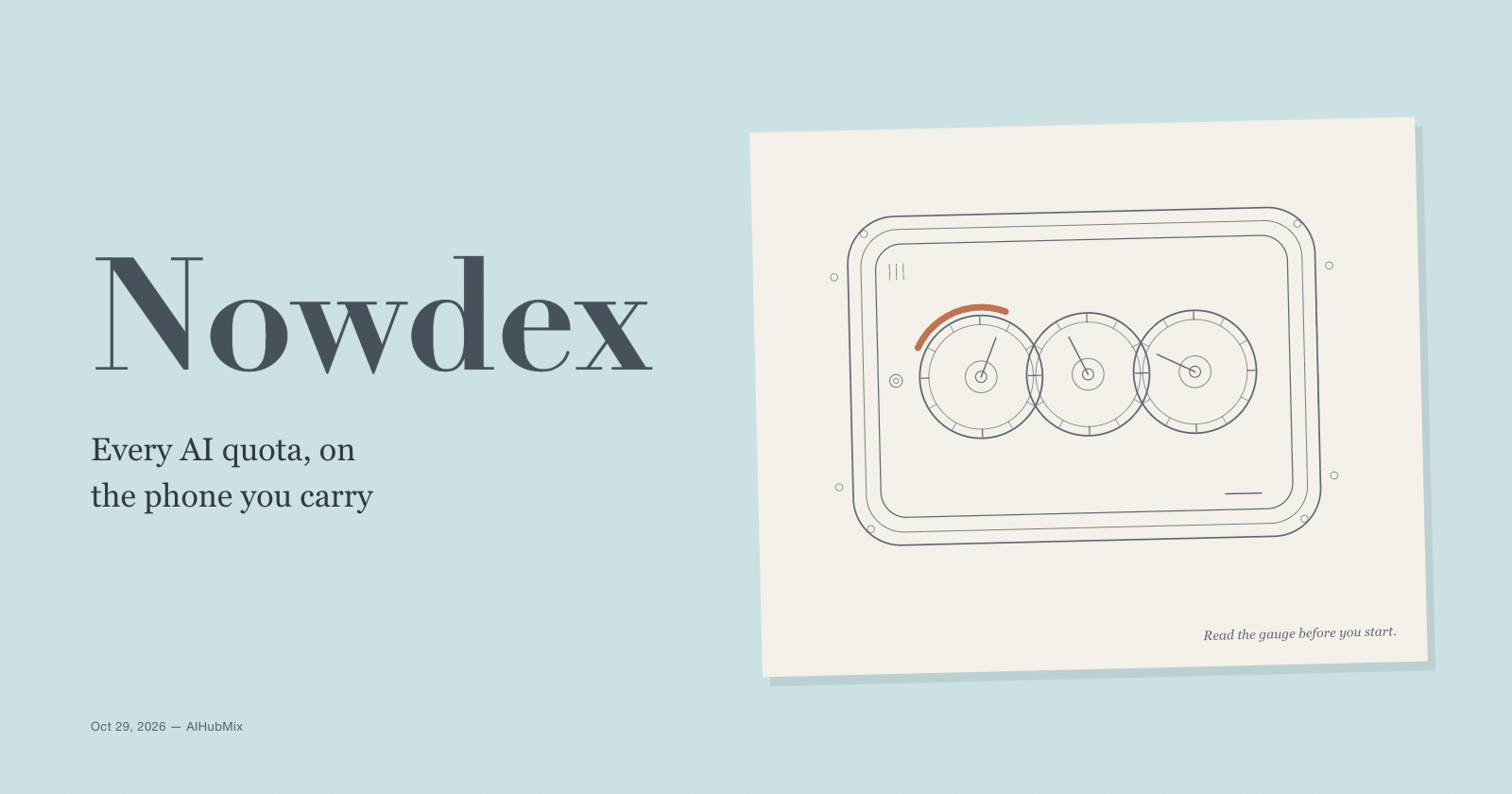
  • Nowdex: your AI subscription quotas, on the screen you're already holding

    Nowdex: your AI subscription quotas, on the screen you're already holding

    If you pay for more than one coding agent, you already know the shape of the problem. Claude has a five-hour window and a weekly one. Codex has a weekly quota with reset credits, and a session window on some plans. Cursor counts usage and spend limits. Each of them reports on a different dashboard, each resets on its own schedule, and none of them is on the phone in your pocket. Nowdex is an app built around that gap. It collects the remaining usage and reset times of the services you already

    8 min readTutorial
  • Genie 4, explained: what world models are, and why Google keeps chasing them

    Genie 4, explained: what world models are, and why Google keeps chasing them

    On October 27, 2026, Google DeepMind announced Genie 4, its newest world model. Unlike an AI video model — which hands you a finished clip — Genie 4 generates a world you step into: it responds to your keyboard every frame, you can rewrite the scene mid-simulation with plain English, and the world now carries its own live sound — wind, footsteps, music, spoken dialogue — instead of a soundtrack laid over video afterwards. The new capabilities are the story, but they are also this moment's clea

    11 min readNews
  • What GPT-6.1 Terra Really Costs: Effort Levels, the 272K Line, and Caching

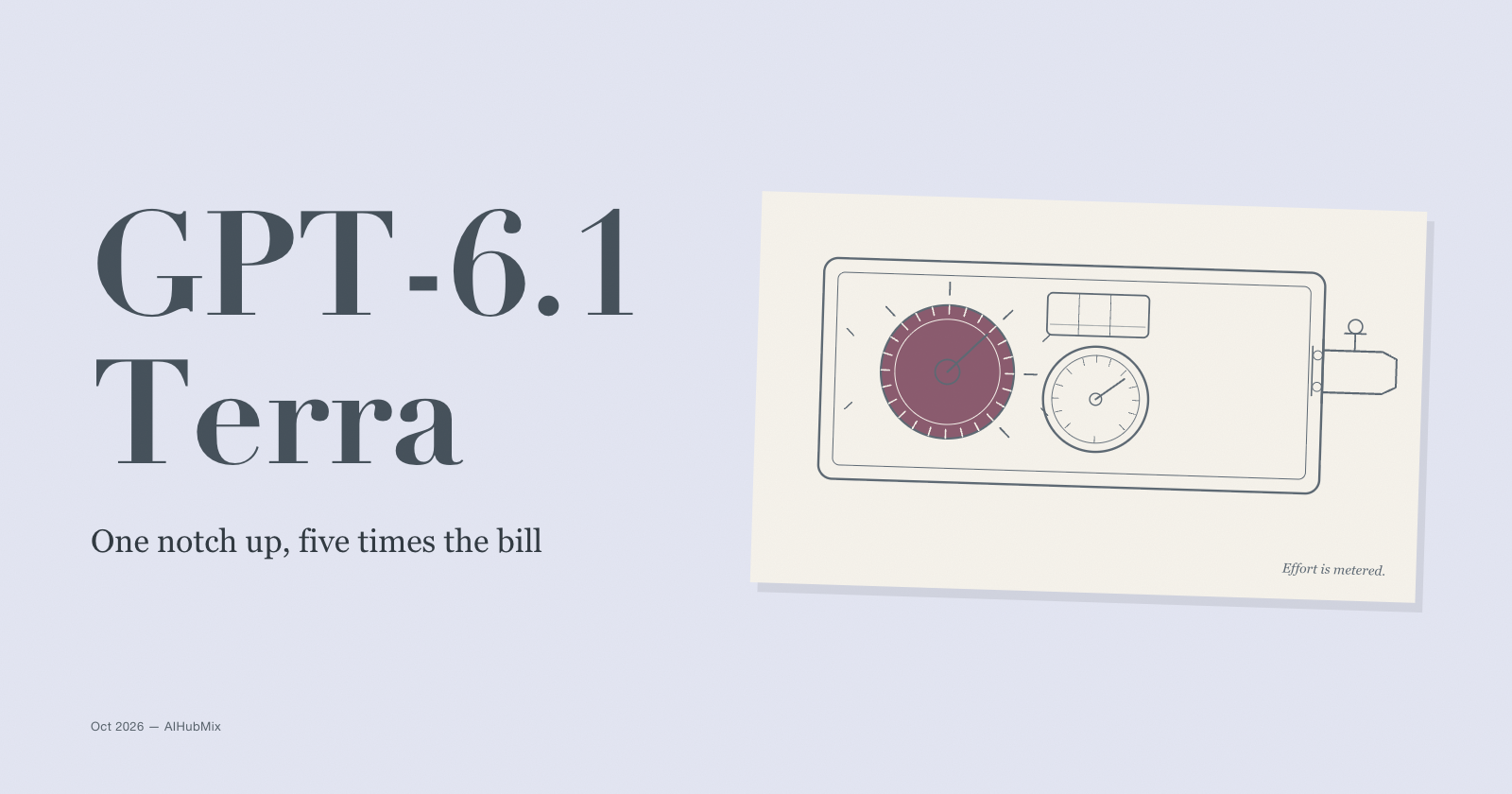
    What GPT-6.1 Terra Really Costs: Effort Levels, the 272K Line, and Caching

    GPT-6.1 Terra launched on 26 October 2026 at $1 per million input tokens and $5 per million output tokens, half of GPT-5.6 Terra's input price and well under half of its $12 output price. The list price is only the starting point. Three things decide what a Terra workload actually bills: * Reasoning effort. Reasoning tokens bill as output, and the gap between effort levels is several-fold. * The 272K line. Once a request's input crosses 272,000 tokens, the whole request moves to a higher rat

    12 min readOpinion
  • GPT-6.1 Terra vs GPT-6.1 Sol: Which Tasks Still Need Sol?

    GPT-6.1 Terra vs GPT-6.1 Sol: Which Tasks Still Need Sol?

    GPT-6.1 Terra costs half as much per token as GPT-6.1 Sol: $1 per million input tokens and $5 per million output, against Sol's $2 and $10. OpenAI released Sol in late September 2026 and Terra on 26 October, and the Terra launch post puts it close to Sol on several evaluations. Half the price per token is not the same as half the price per task. The difference comes from reasoning effort. At medium, Terra is cheap, fast and good enough for most extraction, screen and document work. When a task

    10 min readOpinion
  • GPT-6.1 Terra vs Claude Sonnet 5.5: Which Mid-Tier Model for Screen and Document Agents?

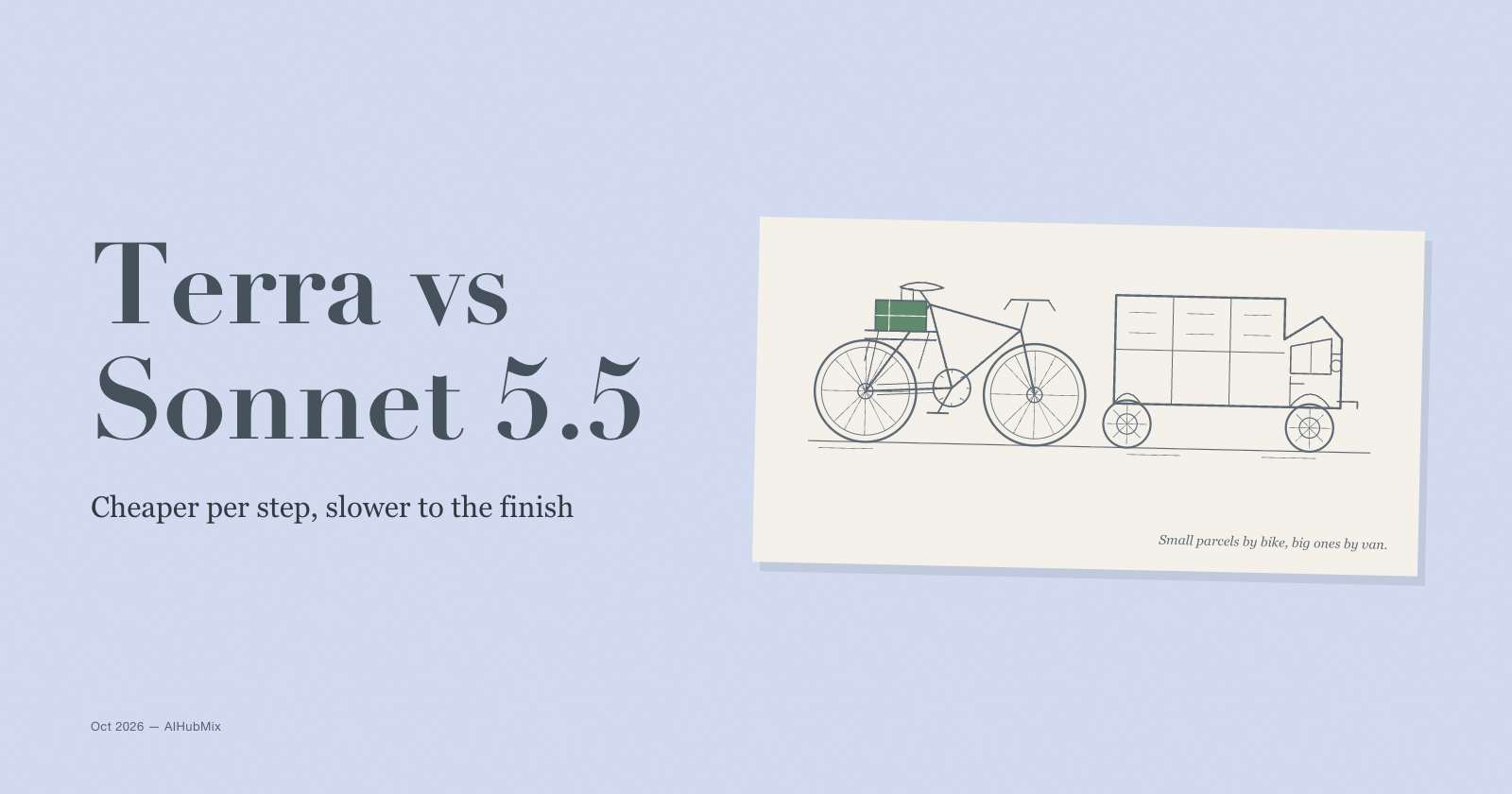
    GPT-6.1 Terra vs Claude Sonnet 5.5: Which Mid-Tier Model for Screen and Document Agents?

    OpenAI released GPT-6.1 Terra on 26 October 2026, four weeks after Anthropic shipped Claude Sonnet 5.5. OpenAI's launch post set Terra against Claude Opus 5.5, but the coverage drew a different line. The Decoder called Terra "OpenAI's closest competitor to Anthropic's mid-tier Sonnet series at half the price", and AlphaCorp called Terra against Sonnet "the real fight for the mid tier". GPT-6.1 Sol and Sonnet 5.5 share the same $2 / $10 price card, so a team choosing a mid-tier model this month i

    10 min readOpinion
  • Migrating to GPT-6.1 Terra: Fix the temperature 400s, Move Tools to Responses, and Set Up Codex

    Migrating to GPT-6.1 Terra: Fix the temperature 400s, Move Tools to Responses, and Set Up Codex

    Switching to GPT-6.1 Terra is a one-line change: set the model to gpt-6.1-terra. What happens next depends on which API route the request takes. On the Responses API, Terra follows OpenAI's rules: reasoning effort works, and temperature or top_p return HTTP 400. On AIHubMix's Chat Completions route, the same temperature is accepted without complaint, and in AIHubMix's checks on 27 October 2026, reasoning_effort made no measurable difference on small prompts. So the short answer for most teams:

    13 min readTutorial
  • GPT-6.1 Terra vs GPT-5.6 Terra: Half the Price, What Changed, and Who Should Switch

    GPT-6.1 Terra vs GPT-5.6 Terra: Half the Price, What Changed, and Who Should Switch

    OpenAI released GPT-6.1 Terra on 26 October 2026. It sits below Sol and Astra in the GPT-6 family, and it costs less than its predecessor, GPT-5.6 Terra: $1 per million input tokens instead of $2, and $5 per million output tokens instead of $12. The launch post pitches it for visual reasoning, computer use and writing. OpenAI's benchmarks show it reading screens and images better, and both OpenAI's and independent tests show far fewer factual errors. The short answer for GPT-5.6 Terra users:

    10 min readNews
  • AIHubMix vs OpenRouter (2026): An OpenRouter Alternative Without the 5.5% Credit Fee

    AIHubMix vs OpenRouter (2026): An OpenRouter Alternative Without the 5.5% Credit Fee

    OpenRouter and AIHubMix are both one-key gateways to more than 500 models, and on Claude, GPT, Gemini and Grok they charge the same per-token price: the vendor's list price. So the comparison isn't about the sticker price. It's about what you pay on top of it, how open-weight models get routed, which wire protocols one key speaks, and where your fallback rules live. This page lays those differences out, including the places where OpenRouter is the better pick. The short answer * Pick AIH

    10 min readOpinion
  • Kimi K3.1 Pro vs K3.1 Pro Highspeed: Is 2–3× the Speed Worth 2× the Price?

    Kimi K3.1 Pro vs K3.1 Pro Highspeed: Is 2–3× the Speed Worth 2× the Price?

    Kimi K3.1 Pro Highspeed is not a smarter model. Moonshot AI describes it as K3.1 Pro "with identical model capabilities", running at "approximately 2–3× the speed". At Moonshot's list price it costs exactly twice as much per input and output token. What you buy is wall-clock time, and nothing else. The short answer: pay for Highspeed when a person is watching the stream, as in an interactive coding session or a chat feature your users wait on. Stay on Pro for work that runs unattended or spend

    11 min readOpinion
  • Kimi K3.1 Pro vs Qwen 4 vs Claude Fable 5.5: Front-End Quality, Cost per Task, and the Hype Checked

    Kimi K3.1 Pro vs Qwen 4 vs Claude Fable 5.5: Front-End Quality, Cost per Task, and the Hype Checked

    Three launches converged on the same October week. On 22 October two anonymous models, Kibitz and Kalmia, appeared in Arena's Code Arena a few hours apart. Tokenizer tests tied them to Moonshot's Kimi and Alibaba's Qwen. A day later, Kimi posted a teaser of K3.1 writing a Three.js scene, and soon after the model was out: Moonshot's launch post introduced Kimi K3.1 Pro in the Kimi app, Kimi Code and the Kimi API. On Anthropic's side, a claude-fable-5-5 listing surfaced in a cloud catalogue on 13

    14 min readOpinion